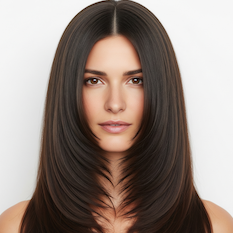
V-Cut: See It on Your Photo
Long hair angled into a V shape at the back, with layers that add movement to the ends. Usually flatters oval, round and square faces.
Included in Free, Creative Spark and Elite Pro
Face shapes it suits
- Oval
- Round
- Square
Seen from behind, a V-cut comes to a clear point in the center of the back, with the sides angling upward toward the face. Layers blended through the ends let the hair swing and taper instead of hanging in a flat line. It needs real length below the shoulder blades or the angle is hard to see.
A V is sharper than its cousin, the U-cut, which curves gently instead of pointing. If your hair is thin, the point can look sparse, so a softer angle or a U shape is often the better call.
From the front, the tapering layers create a sense of length and movement. That usually suits oval faces, lengthens round faces when paired with a few front layers, and softens a square jaw. Thick and medium hair show the V most clearly. A smooth blowout highlights the point, while loose waves add bounce through the ends. A trim every eight to twelve weeks keeps the point defined.
Frequently Asked Questions
- What is the difference between a V-cut and a U-cut?
- A V-cut comes to a noticeable point in the center of the back, while a U-cut has a gentler, rounded curve. The V is usually more dramatic.
- Do I need long hair for a V-cut?
- Generally yes. The shape needs length below the shoulder blades to show clearly; on shorter hair the angle is hard to see.
- Is a V-cut good for thin hair?
- It can make fine ends look sparse at the point. A softer angle, or a U-cut, usually works better if your hair is very thin.