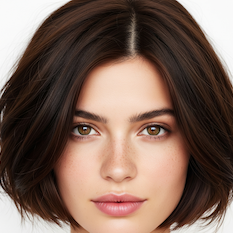
Italian Bob: See It on Your Photo
A fuller, slightly longer bob with bouncy, flipped-out ends. Often flatters oval, heart, oblong and diamond faces and works well for thick hair.
Included in Free, Creative Spark and Elite Pro
Face shapes it suits
- Oval
- Heart
- Oblong
- Diamond
Where the French bob is understated, the Italian bob is generous. It usually falls at or just below the jaw, cut with minimal layering so the perimeter stays full, and the ends flick gently outward. The volume lives at the sides rather than on top, which gives it a rounded, confident outline.
That fullness is what makes it work for so many people. Oblong faces gain horizontal balance, heart faces get width near a narrow chin, and the soft curve of the ends eases the cheekbones of a diamond shape. Oval faces can simply enjoy the bounce. Medium to thick hair holds the shape naturally, and fine hair can fake extra density with a volumizing mousse at the roots.
To style, blow-dry with a large round brush, turning the ends outward as you go, then set everything with a light hairspray. Heated rollers are a quick alternative on busy mornings. Book a trim every six to eight weeks, since the outward bend depends on the ends being healthy.
Frequently Asked Questions
- How is an Italian bob different from a French bob?
- An Italian bob is usually a bit longer, around the jaw or just below, with more volume and outward-flicking ends. A French bob is shorter and more understated.
- What products help an Italian bob keep its bounce?
- A volumizing mousse at the roots before blow-drying and a light hairspray to set the ends usually hold the shape through the day.
- Is an Italian bob good for thin hair?
- It can be, since the fuller shape creates an illusion of density. Ask for minimal layering so the ends do not look wispy.